

















 Listen to Our Blogs
Industrial Lease Renewal vs. Relocation: How to Choose the Right Facility for Your Business
 August, 2026 . 8–9 min read

Most industrial facilities don’t become the wrong fit overnight. More often, the mismatch develops gradually as businesses evolve. Additional inventory, new equipment, growing workforces, changing customer demands, or shifts in supply chains slowly push a building beyond its original purpose. In other cases, companies find themselves paying for space they no longer fully utilize.
As a lease expiration approaches, the question is no longer whether the facility has served the business well. The real question is whether it remains the right facility for where the company is today—and where it plans to be in the years ahead.
An industrial lease renewal is one of the most important operational and financial decisions a business will make. Yet many companies approach this industrial lease decision by comparing rental rates instead of evaluating how their facility affects productivity, transportation costs, employee recruitment, customer service, and long-term growth.
The right answer is rarely determined by rent alone.
At Allies Commercial Realty, we work with manufacturers, distributors, and logistics companies throughout Indiana’s industrial market, and we’ve found that the strongest real estate decisions begin long before a lease expires. Companies that evaluate their options early have more negotiating leverage, a broader selection of available properties, and more time to make decisions based on business strategy rather than lease deadlines.
Why Your Facility Matters More Than You Think
Your industrial facility influences far more than occupancy costs. It affects nearly every aspect of your operation—from employee productivity and shipping efficiency to customer satisfaction and long-term profitability.
When a building no longer supports the way your business operates, the consequences often appear in places that are easy to overlook:
- Increased labor hours caused by inefficient workflows
- Higher transportation costs due to changing customer or supplier locations
- Limited storage capacity that slows production or fulfillment
- Difficulty recruiting and retaining employees because of the facility’s location
- Inability to expand operations without significant capital investment
Conversely, the right facility creates efficiencies that compound over time. Better warehouse layouts improve productivity. Strategic locations reduce transportation expenses. Modern buildings support automation, technology, and future expansion. These operational improvements often have a greater impact on profitability than modest differences in rental rates.
Labor is also one of the largest operating expenses for many manufacturers, warehouse operators, and logistics companies. Even small improvements in workflow, travel paths, or facility design can create meaningful long-term savings when multiplied across an entire workforce.
According to the U.S. Bureau of Labor Statistics, the warehousing and storage industry employs more than 1.8 million people in the United States. As labor is typically one of the largest operating expenses for warehouse and manufacturing businesses, facility efficiency can have a significant impact on long-term operating performance.
One misconception we frequently encounter is that a lower lease rate automatically represents a better deal. In reality, a facility with a slightly higher rent may reduce labor costs, improve shipping efficiency, or eliminate operational bottlenecks—creating a much stronger long-term financial outcome.
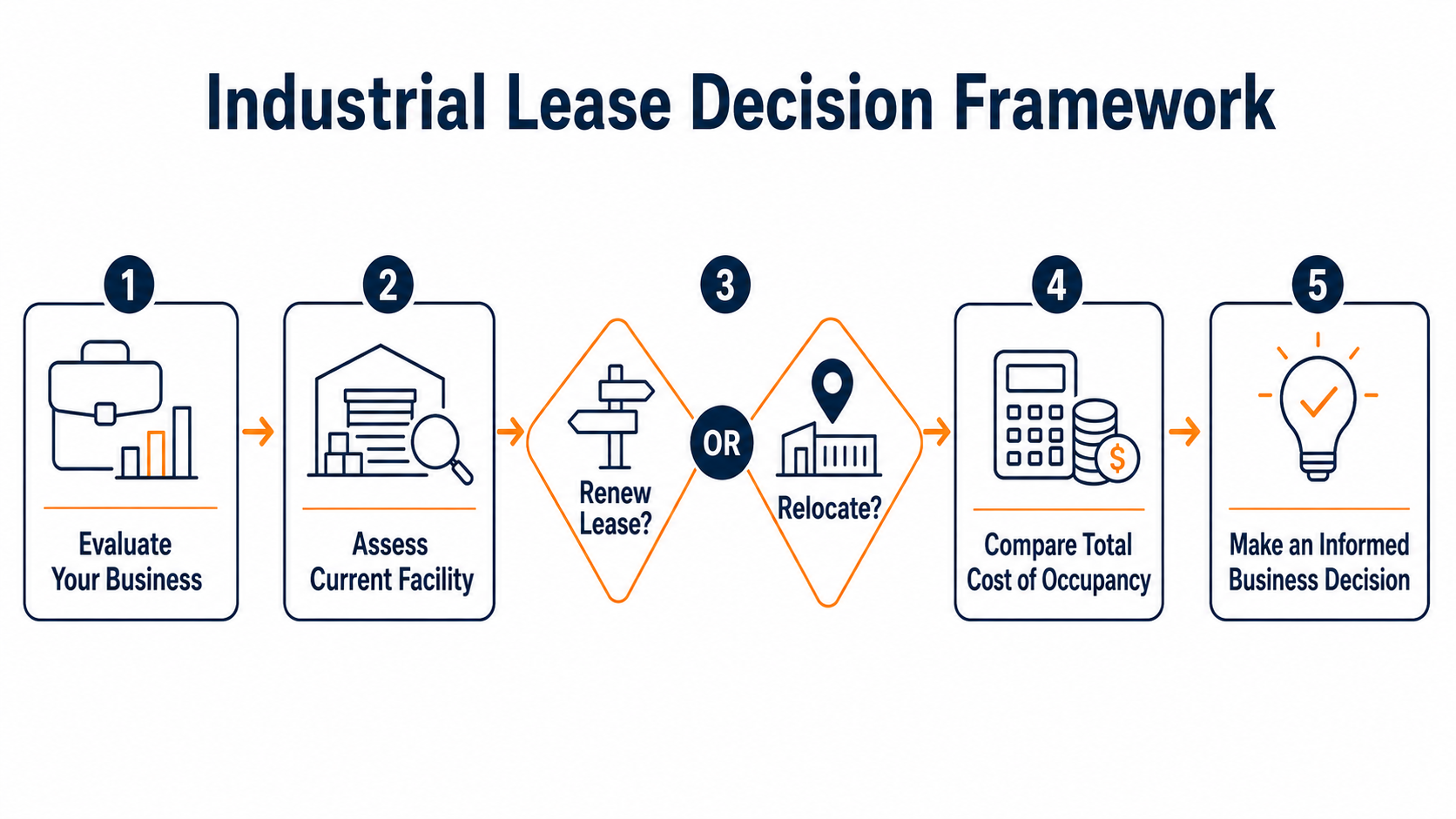
That is why every industrial lease decision should evaluate the total cost of occupancy, not simply the monthly rent.
Evaluate Your Business Before You Evaluate Buildings
Before comparing available properties or negotiating an industrial lease renewal, take a step back and evaluate how your business has changed since signing your current lease.
Ask yourself:
- Has your business grown or downsized?
- Have inventory levels or production requirements changed?
- Are your warehouse layout and dock configuration still efficient?
- Has automation or new equipment changed your space requirements?
- Is your current location helping—or hurting—employee recruitment?
- Have your customers or suppliers shifted to different markets?
- Can this facility support your business over the next five years?
These questions often reveal whether your current building continues to support your business—or whether it has quietly become a constraint on growth.
From our experience, one of the biggest mistakes companies make is evaluating the building before evaluating the business. A successful facility strategy begins with understanding your operational goals first. Only then can you determine whether renewing your lease or relocating creates the greatest long-term value.
When an Industrial Lease Renewal Makes Sense
Relocating isn’t always the right answer. In many cases, renewing an existing lease provides greater operational continuity and stronger financial returns.
An industrial lease renewal is often the better choice when:
- Your operations continue running efficiently.
- The location still provides strong access to employees, customers, suppliers, and transportation corridors.
- You’ve invested significantly in tenant improvements, equipment, or specialized infrastructure.
- The building can accommodate future growth.
- The cost and disruption of relocating outweigh the potential benefits.
For many businesses, remaining in a facility that already supports daily operations allows leadership to focus capital on expansion, technology, equipment, and workforce development rather than relocation expenses.
One example we frequently see throughout Indiana’s industrial market is manufacturers who have invested heavily in electrical upgrades, cranes, compressed air systems, specialized production lines, or automation infrastructure. Recreating those improvements elsewhere can dramatically increase the true cost of relocation.
A lease renewal should never happen simply because moving feels difficult. It should happen because the facility continues supporting the company’s operational, financial, and long-term business objectives.
When Relocating Creates Greater Long-Term Value
Eventually, some facilities begin limiting growth instead of supporting it.
When that happens, relocation becomes less about finding a new address and more about improving the business itself.
Relocation should be considered when:
- Your facility no longer has sufficient capacity.
- Warehouse workflows have become inefficient.
- Hiring qualified employees has become increasingly difficult.
- Transportation costs continue rising because of changing logistics patterns.
- The building cannot support automation, operational improvements, or future expansion.
Throughout Indiana’s industrial market, we’ve also seen companies reevaluate their locations based on access to major transportation corridors such as I-65, I-69, I-70, I-74, I-465, and Indianapolis International Airport. As customer expectations continue shifting toward faster delivery and greater supply chain flexibility, location has become an increasingly important competitive advantage.
A successful relocation should solve meaningful business challenges—not simply replace one building with another.
The Hidden Costs Businesses Often Overlook
Comparing rental rates is relatively straightforward. Understanding the true cost of relocating is much more complex.
Many businesses focus on lease rates and moving expenses while overlooking costs that don’t appear in the initial budget. Depending on the operation, these hidden expenses can significantly influence the overall financial outcome of a relocation.
Some of the most common include:
- Production downtime during the move
- Equipment disassembly and reinstallation
- IT and network migration
- Utility upgrades or permitting
- Inventory transfers
- Temporary productivity losses
- Employee training and workflow adjustments
- New office or warehouse improvements
For manufacturers and distribution companies, even a few days of disruption can have lasting operational and financial consequences.
This doesn’t mean relocation is the wrong decision—it simply reinforces the importance of evaluating the total cost of occupancy, not just the lease rate.
Related Resource: Before relocating your operation, read our guide on the hidden costs of moving an industrial facility to better understand the operational and financial expenses that are often overlooked during the planning process.
An experienced commercial real estate advisor can help identify these costs early, allowing businesses to compare renewal and relocation on equal terms.
Renew vs. Relocate: A Quick Comparison
Every business has unique operational requirements, but the following framework can help determine which path is more likely to support your long-term business goals.
| Renew Your Lease When… | Relocate When… |
|---|---|
| • Operations remain efficient | • Space is limiting productivity |
| • The location continues supporting employees, customers, and suppliers | • Hiring, logistics, or transportation have become challenges |
| • Existing tenant improvements provide significant value | • The building no longer supports your operational needs |
| • The facility can accommodate future growth | • Expansion is no longer possible |
| • Relocation costs outweigh potential savings | • Long-term operational improvements justify the investment |
Ultimately, the best industrial lease decision depends on your business objectives—not simply which property offers the lowest rental rate.
How a Commercial Real Estate Broker Can Help
One of the biggest misconceptions about commercial real estate is that businesses only need a commercial real estate broker after deciding to relocate.
In reality, involving a broker much earlier often leads to better business decisions—even when the outcome is an industrial lease renewal.
An experienced commercial real estate broker brings market knowledge, negotiation expertise, and an objective perspective to the evaluation process. Instead of simply identifying available properties, they help businesses determine whether their current facility continues to support operational goals and long-term growth.
A broker can help you:
- Analyze current and future space requirements.
- Compare the total cost of occupancy—not just rental rates.
- Evaluate market conditions and available alternatives.
- Benchmark renewal proposals against current market trends.
- Strengthen your negotiating position with landlords.
- Develop a timeline that minimizes operational disruption.
At Allies Commercial Realty, we approach every assignment as business advisors first and real estate professionals second. We work with manufacturers, distributors, logistics companies, and industrial users throughout Indiana’s industrial market, helping them evaluate facilities through the lens of operations, workforce, logistics, and long-term business strategy.
Whether the right solution is renewing your current lease or relocating to a new facility, our objective remains the same: helping you make a confident, informed decision that supports your business for years to come.
Frequently Asked Questions
How early should I begin evaluating an industrial lease renewal?
Ideally, businesses should begin evaluating their options 12 to 18 months before lease expiration. Starting early provides greater negotiating leverage, a wider selection of available properties, and sufficient time to evaluate both renewal and relocation without unnecessary pressure.
Is renewing an industrial lease usually less expensive than relocating?
Not always.
While renewal often avoids relocation expenses and operational disruption, it is not automatically the most cost-effective option. If your current facility limits productivity, labor availability, transportation efficiency, or future growth, relocating may provide greater long-term financial value despite higher upfront costs.
How do I know if my business has outgrown its industrial facility?
Some of the most common indicators include:
- Limited storage capacity
- Congested warehouse workflows
- Insufficient dock doors
- Difficulty hiring or retaining employees
- Rising transportation costs
- Limited room for expansion or automation
If your facility is beginning to limit productivity or business growth, it may be time to evaluate alternative options.
Should I hire a commercial real estate agent before negotiating a lease renewal?
Yes.
Many businesses assume representation is only valuable when relocating. However, an experienced commercial real estate agent or commercial real estate broker can also provide market intelligence, benchmark lease terms, evaluate alternative properties, and strengthen your negotiating position during renewal discussions.
Conclusion
Choosing between an industrial lease renewal and relocation is about far more than real estate. It is a strategic business decision that influences productivity, operating costs, employee recruitment, customer service, and long-term profitability.
The right facility should support where your business is today while giving you the flexibility to grow tomorrow. Sometimes that means maximizing the value of your existing location. Other times, it means relocating to a property better aligned with your operational and financial objectives.
The most successful companies don’t make these decisions based solely on rental rates. They evaluate how each option supports the overall performance of the business and positions them for future growth.
Whether your next move is renewing your lease or relocating to a new facility, taking the time to evaluate your operations, understand current market conditions, and compare the total cost of each option will help ensure your real estate supports your business—not limits it.
Ready to Make Your Next Industrial Lease Decision?
Not sure whether renewing your lease or relocating creates the strongest financial outcome?
Whether your lease expires in a few months or a few years, planning ahead gives you more options, stronger negotiating power, and greater confidence in your decision.
Schedule a complimentary Industrial Facility Strategy Session with an industrial advisor at Allies Commercial Realty. We’ll help you objectively evaluate both options, compare the financial and operational impacts, and determine which path best supports your long-term business goals.
Topic: Industrial Tenant Representation

About the Author
Mitchell Ayers | Industrial Broker
Mitchell specializes in industrial leasing, sales, and tenant representation throughout Central Indiana. He works closely with manufacturers, distributors, logistics companies, and business owners to help them evaluate facilities and make informed real estate decisions that support long-term operational growth.
Reviewed by
Adam Stephenson, CCIM, SIOR
Managing Director
Download Our Free Resource:
The Future of Industrial Real Estate in Indiana:
E-Commerce and Beyond
You might also enjoy reading:


Cookies improve your browsing experience, deliver tailored ads or content, and assess our website traffic. If you click 'Accept All’ you are giving your consent for us to utilize cookies. Check our cookies policy here.
Adding {{itemName}} to cart
Added {{itemName}} to cart