
















 Listen to Our Blogs
Second-Generation vs. Shell Retail Space: Which Is Better for Your Business?
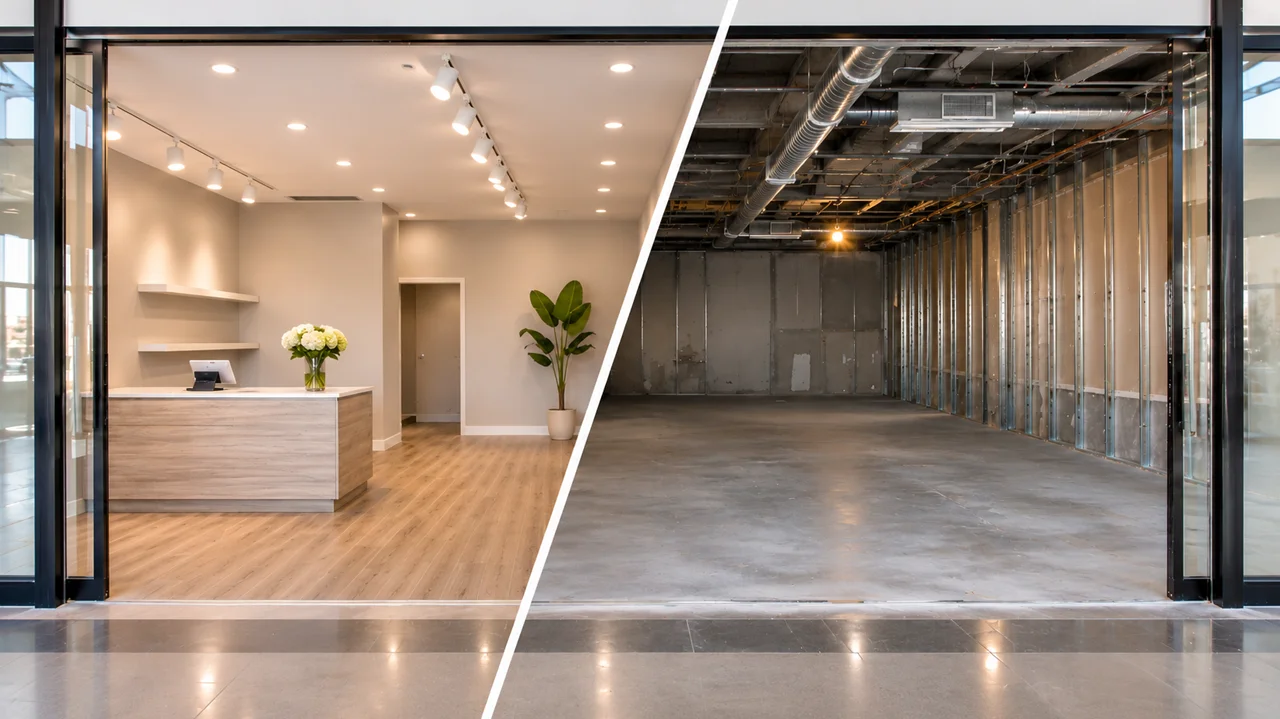

You’ve found two retail spaces in Indianapolis that could work for your business. One was previously occupied and already has walls, lighting, restrooms, and other improvements. The other is a blank canvas where you can build exactly what you need.
Both have similar rental rates. So which one is the better deal?
The answer isn’t necessarily the space with the lowest construction estimate or the largest tenant improvement allowance. It’s the one that makes the most financial sense when you consider upfront costs, construction timelines, available cash, and long-term occupancy expenses.
At Allies Commercial Realty, we help business owners evaluate these differences before committing to a lease. Here’s what to consider when comparing second-generation retail space with shell space in Indianapolis and Central Indiana.
Second-Generation Retail Space vs. Shell Space: What’s the Difference?
Second-generation retail space is a property that was previously occupied and already has some interior improvements in place. Depending on its previous use, it may include finished walls, restrooms, lighting, HVAC, plumbing, flooring, or fixtures.
The financial advantage comes from what your business can reuse.
For example, a former salon might already have valuable plumbing and electrical infrastructure for another salon. However, that same layout could require significant demolition for a clothing retailer that needs an open sales floor.
Shell space is typically delivered with some or most interior improvements still to be completed. A cold shell generally requires more work, while a warm shell may include certain building systems or finishes.
The terms aren’t standardized across every landlord or development, so it’s important to review the written delivery specifications.
Before comparing costs, establish whether the landlord will provide finished flooring, HVAC, electrical service, restrooms, and utility connections ready for your contractor.
| What to compare | Second-generation retail space | Shell space |
|---|---|---|
| Starting condition | Existing layout and systems that may be reusable | Interior improvements depend on the landlord’s delivery specifications |
| Main budget risk | Demolition, repairs, or upgrades to accommodate a different use | Construction and utility costs missing from the initial estimate |
| Opening timeline | Potentially shorter if the existing layout and systems meet your needs | Depends on design, permitting, construction, and inspections |
| Customization | May require adapting an existing layout | Greater flexibility to design around your business |
| Best fit | Businesses that can reuse much of the existing buildout | Businesses with specialized layout or system requirements |
Neither option is automatically better. The key is understanding how much work is required to make the property operational for your specific business.
What Can You Reuse in a Second-Generation Retail Space?
One of the biggest advantages of second-generation retail space is the potential to reduce construction costs by reusing improvements already in place.
But existing improvements don’t always translate into savings.
A former retailer’s lighting and checkout counter may be worth keeping, while its HVAC system could be nearing replacement. An existing stockroom might be useful for one business but occupy valuable sales floor space for another.
Before committing to a buildout budget, walk the property with a qualified contractor and evaluate:
- HVAC systems: Are they in good working condition and appropriately sized for your business?
- Electrical capacity: Can the existing service support your equipment and operations?
- Plumbing: Are the existing connections and fixtures suitable for your use?
- Layout: Can you operate efficiently within the current floor plan?
- Fixtures and equipment: What stays with the property, and what belongs to the previous tenant?
- Building compliance: Will your proposed business use require additional improvements or approvals?
For restaurants and food-service businesses, existing kitchen equipment, ventilation hoods, or grease interceptors can be particularly valuable. However, their presence doesn’t guarantee they meet the needs of your concept or current code requirements.
The Indiana Department of Homeland Security’s building plan review guidance explains that even projects exempt from state filing may still require local permits.
Before relying on an estimated opening date, confirm the applicable zoning, permitting, inspection, and occupancy requirements with the appropriate authorities.
Local Example: Existing Retail Space on Indianapolis’ Keystone Corridor
The Boardwalk Shoppes retail space at 5351 N. Keystone Avenue illustrates the potential advantages of an existing retail buildout.
The Allies listing describes a 1,260-square-foot suite in good condition with a full buildout already in place.
For a retailer whose layout and operational requirements match the existing improvements, this type of space may present an opportunity to reduce construction work and accelerate the opening process.
However, a finished space isn’t automatically a less expensive option.
A business should still obtain contractor estimates, evaluate the condition of existing systems, and compare the cost of adapting the property against other available spaces.
The real value of a second-generation space depends on how much of the existing buildout your business can actually use.
What Should the Landlord Deliver in a Shell Space?
Shell space can offer greater flexibility, especially for businesses with specific layouts, equipment requirements, or customer experience goals.
A restaurant may need a specialized kitchen layout, while a fitness studio might prioritize open floor space, specific flooring, and additional restroom facilities.
Starting with a shell can make it easier to design around those needs rather than modifying an existing configuration.
However, that flexibility often comes with additional construction costs and responsibilities.
One of the most important documents to review is the work letter, which outlines the construction responsibilities of the landlord and tenant.
For example, a landlord’s proposal might state that utilities are available. But does that mean the utility service is located at the building, or is it connected and ready for use inside your suite?
That distinction can significantly affect your construction budget.
As the American Bar Association explains in its guidance on lease work letters, construction responsibilities and payment obligations should be clearly defined in the lease.
Before signing, confirm:
- What improvements the landlord will complete before delivery
- Which construction costs are your responsibility
- Whether utilities will be connected and operational
- Who is responsible for obtaining permits and approvals
- When the space will be delivered to you
- When rental payments and additional operating expenses begin
Your Rent Commencement Date Matters
One important consideration is that the date you receive possession of the space, the date rent begins, and the date your business opens may be different.
For example, you may receive possession of a retail suite in January, begin paying rent in March, and not open until April because construction or permitting takes longer than expected.
That creates a period when you’re paying occupancy costs without generating revenue.
Depending on the lease, you may be able to negotiate free rent, a construction period, or other rent commencement provisions that provide additional flexibility.
Be sure to confirm whether any negotiated rent abatement applies only to base rent or also includes expenses such as common area maintenance (CAM), property taxes, and building insurance.
How Tenant Improvement Allowances Affect Your Opening Budget
A tenant improvement allowance (TI allowance) is a landlord contribution toward eligible improvements needed to prepare a commercial space for occupancy.
It can be an important part of a retail lease negotiation, particularly when a tenant needs to make significant modifications to the property.
However, a larger TI allowance doesn’t necessarily mean a better financial deal.
One important factor is when the funds become available.
Some landlords provide payments through construction draws as work progresses. Others reimburse the tenant after construction has been completed and the required documentation has been submitted.
If reimbursement occurs after construction, your business may need to fund the improvements upfront.
Before treating the allowance as available cash, confirm:
- The total allowance offered
- Which construction and professional costs are eligible
- When payments or reimbursements will be made
- What documentation the landlord requires
- Who pays for improvements that exceed the allowance
- Whether unused funds expire or can be applied to other negotiated expenses
Map the expected allowance payments against your contractor’s payment schedule.
This will help you understand not only the total cost of the project, but also how much working capital your business will need during construction.
Real-World Budget Comparison: Two 2,500 SF Retail Spaces
Let’s compare two hypothetical retail spaces for a specialty retailer planning to open in Indianapolis.
The first is a second-generation space that already has usable restrooms, lighting, and much of the desired layout.
The second is shell space requiring more extensive construction but offering a larger tenant improvement allowance.
| Budget component | Second-generation space | Shell space |
|---|---|---|
| Construction and system work | $95,000 | $155,000 |
| Design and permits | $12,000 | $18,000 |
| Rent and occupancy costs before opening | $18,000 | $25,000 |
| Construction contingency | $15,000 | $23,000 |
| Pre-opening property budget | $140,000 | $221,000 |
| Assumed TI reimbursement | ($25,000) | ($85,000) |
| Net funding after reimbursement | $115,000 | $136,000 |
These figures are hypothetical and are not Indianapolis market estimates. They cover property preparation and pre-opening occupancy costs, not the full cost of launching a business. Additional expenses may include signage, inventory, equipment, furniture, deposits, hiring, marketing, and operating reserves. Construction contingencies are included as reserved funds, so actual spending may differ.
What Do These Numbers Tell Us?
At first glance, the second-generation space appears to be the more affordable option.
If both allowances are reimbursed after opening:
- The second-generation space requires approximately $140,000 upfront.
- The shell space requires approximately $221,000 upfront.
- That’s an $81,000 difference in initial funding needs.
After the assumed TI reimbursements, the difference drops to $21,000.
A business might be comfortable with that $21,000 long-term difference but still lack the additional cash needed to fund the shell construction before reimbursement.
Now consider another scenario.
Suppose the second-generation space requires an additional $25,000 in electrical and HVAC upgrades beyond its construction contingency, with no additional reimbursement.
Its net funding requirement would increase to $140,000, compared with $136,000 for the shell.
Suddenly, the shell space could become the less expensive option for property preparation after reimbursement.
This is why an existing buildout shouldn’t automatically be considered the cheaper choice.
It’s also important to remember that these figures don’t account for differences in rental rates, annual increases, or other costs over the full lease term.
Which Option Makes More Sense for Your Business?
The right choice depends on your business model, opening timeline, available capital, and the improvements required to operate successfully.
When Second-Generation Retail Space May Be the Better Choice
An existing retail space may make more sense when:
- You can reuse most of the current layout and building systems.
- Your business needs to open within a shorter timeframe.
- You want to minimize upfront construction expenses.
- Existing plumbing, electrical, HVAC, or other improvements meet your needs.
- You prefer to preserve working capital for inventory, staffing, and operations.
For example, a beauty salon moving into a former salon may be able to reuse existing plumbing, treatment rooms, and other infrastructure, potentially reducing both construction costs and the time needed to open.
However, a professional evaluation of the existing improvements is still important.
When Shell Retail Space May Be the Better Choice
Shell space may be worth prioritizing when:
- Your business requires a specialized layout or infrastructure.
- Modifying an existing buildout would require substantial demolition.
- The landlord offers a competitive construction contribution.
- You have sufficient capital to fund the project and manage reimbursement timing.
- Your opening schedule allows for design, permitting, and construction.
For a business with specific operational requirements or a distinctive customer experience, the ability to design a space from the beginning can offer meaningful advantages.
A Lesson From Allies’ Retail Brokerage Experience
Finding the right retail space involves more than identifying available square footage.
When Allies Commercial Realty represented Velvet Roast in its search for a new Westfield location, retail broker Daniel Santana focused on the specific requirements of the coffee concept, including visibility, accessibility, surrounding demographics, and drive-thru capability.
The search led to a 1,708-square-foot endcap space at Bonterra with an existing drive-thru lane.
While this transaction wasn’t presented as a comparison between second-generation and shell space, it demonstrates a broader principle: the right retail property should support the way your business actually operates.
Construction costs matter, but so do the physical characteristics of the property, the customer experience, and the long-term business strategy.
Compare the Total Cost Before Signing a Retail Lease
Your construction budget is only part of the financial picture.
Before choosing a property, compare the full cost of occupying each space over the same period.
Depending on the lease structure, your budget may need to include:
- Base rent and scheduled rental increases
- Common area maintenance (CAM)
- Property taxes and building insurance
- Utilities and separately billed maintenance
- Construction costs exceeding the TI allowance
- Signage and equipment
- Rent payments before opening
- Potential restoration obligations when the lease expires
If you’re comparing triple net properties, our guide to NNN leases explains how additional property expenses can affect your total occupancy costs.
A larger TI allowance might be attractive, but it could be offset by higher rental rates or other lease obligations.
Evaluate the entire proposal rather than a single financial incentive.
Documents to Request Before Committing
| Ask for | What it helps you verify |
|---|---|
| Written delivery specifications and work letter | Which improvements the landlord will provide and when |
| Contractor estimate based on a site visit | What can be reused, repaired, removed, or installed |
| List of included fixtures and equipment | What stays with the property and what must be purchased |
| TI allowance terms and payment schedule | How much construction cash you need upfront |
| Rent commencement and abatement provisions | What you’ll owe before your business opens |
| Preliminary zoning and permitting review | Whether your proposed use and timeline are realistic |
| Operating expense estimates | What you’ll pay beyond the advertised base rent |
It’s also worth preparing for delays.
Consider what happens if construction or permitting takes an extra month. How much additional rent, utilities, and other expenses would your business incur before generating revenue?
Keep a separate reserve for potential opening delays rather than relying entirely on your construction contingency.
Your business should have sufficient capital not only to complete the buildout but also to support inventory, payroll, and operations after opening.
Frequently Asked Questions
Is second-generation retail space always cheaper than shell space?
No. Existing improvements can reduce construction costs, but they may also require demolition, repairs, or upgrades. Shell space can be more competitive when a landlord provides a substantial improvement allowance or when the existing buildout would be expensive to modify.
Compare construction estimates, funding requirements, and total lease costs before deciding.
How much does it cost to build out retail space in Indianapolis?
Retail buildout costs vary significantly depending on the property’s existing condition, business use, required improvements, materials, and construction schedule.
A restaurant with specialized kitchen equipment will generally have different requirements from a boutique or professional service business.
Rather than relying on a broad cost-per-square-foot estimate, obtain a preliminary contractor estimate for each property you’re considering.
Can I negotiate a tenant improvement allowance?
Yes. Tenant improvement allowances are commonly negotiated as part of commercial lease proposals.
The amount a landlord may offer depends on factors such as the property, lease term, rental rate, tenant qualifications, and market conditions.
The payment schedule and eligible expenses are just as important as the total allowance.
Can lease restrictions prevent me from operating my business?
Yes. A lease’s permitted-use clause, prohibited-use provisions, or another tenant’s exclusive rights may restrict your operations, even if local zoning allows the business.
Have your attorney confirm that the lease permits your intended use, including products or services you may want to add later.
What signage costs should I consider?
Confirm whether the property includes building signage, monument or pylon signage, or other advertising opportunities.
Budget for design, fabrication, installation, electrical work, and any separate signage fees.
Landlord approval and local sign regulations may also affect what you can install.
What happens if I don’t use my entire TI allowance?
It depends on the lease.
Unused funds may expire rather than becoming cash or a rent credit. Some landlords may agree to alternative uses of remaining funds, but those arrangements should be negotiated and documented in writing.
Will I have to remove my improvements when the lease ends?
Possibly.
Some commercial leases require tenants to remove certain improvements or restore the space to a specified condition when they vacate.
Review the surrender and restoration provisions with your attorney before signing, particularly if your business requires specialized construction.
Finding the Right Retail Space Starts With Understanding the Full Cost
Choosing between second-generation retail space and shell space isn’t just about comparing rental rates or construction estimates.
It’s about finding a property that supports your business operations, opening timeline, financial resources, and long-term growth.
An existing retail space may help you open sooner and conserve capital. A shell may provide the flexibility to create a layout that better supports your business.
The right decision comes from understanding the total financial commitment and identifying potential challenges before signing the lease.
At Allies Commercial Realty, our retail specialist Daniel Santana helps businesses throughout Indianapolis and Central Indiana evaluate retail properties, compare lease proposals, and negotiate commercial terms that align with their business goals.
Whether you’re opening your first storefront, relocating, or expanding into another market, our team can help you make a more informed real estate decision.
Let’s find the right space for your business.
This article is provided for general informational purposes and does not constitute legal, tax, engineering, or construction advice. Lease terms and property requirements vary. Consult qualified legal counsel, contractors, and applicable authorities before making leasing or construction commitments.
Topic: Retail Leasing
Download Our Free Resource:
The Future of Industrial Real Estate in Indiana:
E-Commerce and Beyond
You might also enjoy reading:


Cookies improve your browsing experience, deliver tailored ads or content, and assess our website traffic. If you click 'Accept All’ you are giving your consent for us to utilize cookies. Check our cookies policy here.
Adding {{itemName}} to cart
Added {{itemName}} to cart