


















 Listen to Our Blogs
How Non-Exclusive Agreements Hurt Your Chances at the Best Deal


One of the most fundamental human instincts is fear, and it’s easy to see why clients are drawn to non-exclusive agreements because of it. It is fueled by the fear of missing out on the perfect property, settling for limited options, or placing trust in a single advisor. But in reality, when you have numerous commercial real estate brokers navigating the same maze with different maps, each drawn differently from their own perspective, your route becomes tangled, your progress slows, and the best destinations may remain just out of reach. This article unpacks why non-exclusive agreements, while seemingly appealing, can actually create challenges that slow down your success. We’ll look at how exclusivity builds priority, prevents mixed messages and signals, enhances collaboration, and ultimately protects your deal from falling apart.
Why Non-Exclusive Agreements Seem Appealing?
By signing a non-exclusive broker-client agreement, clients can work with multiple brokers simultaneously, which is a smart move. On the surface, this approach offers diverse market insights and access to more properties, giving clients a sense that they’re increasing their chances of finding the ideal space faster. However, a multi-brokerage strategy often leads to confusion, diluted effort, and misaligned communication. Rather than creating more opportunities, it can scatter focus, reduce a broker’s commitment, and ultimately complicate or slow down the leasing or purchasing process.
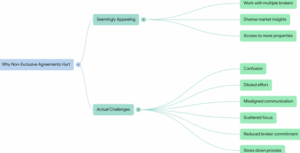
Mindmap: Why Non-Exclusive Agreements Hurt
Commitment Builds Priority
Commercial tenant brokers invest a significant amount of time researching, negotiating, and navigating each deal. The commitment a client shows directly influences how much time, effort, and resources a broker will dedicate to that client’s search. Like in any professional relationship, clients who demonstrate commitment naturally receive higher priority. The level of motivation a broker has is much greater for committed clients than for those who do not commit. Here’s why:
Reserving Prime Opportunities for Exclusive clients
Among the many clients a commercial brokerage firm manages, there is always a select group that receives the highest level of attention. Whether it’s a landlord easing on rent, revising terms, or a property becoming available, this group hears about these insights and updates well before non-exclusive clients. Brokers naturally prioritize sharing their most promising opportunities with clients who have demonstrated loyalty, knowing their commitment is likely to result in a successful transaction. This advantage can make all the difference between securing a sought-after space and missing out entirely.
Stronger advocacy, not scattered effort
Exclusivity builds a foundation of mutual trust between broker and client. When a broker knows they have a committed partner, they become fully invested in the client’s success. That trust encourages brokers to go further, negotiating more aggressively, resolving challenges quickly, and dedicating themselves in ways they might not otherwise. A committed broker doesn’t hesitate to invest energy into digging deeper, reaching out to their closest contacts, and pursuing even the most difficult-to-access landlords because they know their dedication will lead to results. Rather than spreading their energy thin across many uncertain prospects, a committed broker focuses all their effort on securing the best possible deal for their exclusive client.
Access to Hidden Inventory
In many cases, the best commercial spaces never make it to public listings. These off-market properties remain quietly available through the trusted relationships between brokers and landlords. Brokers are far more likely to share these exclusive, unadvertised opportunities with their committed clients. By working exclusively with a broker, clients gain access to a hidden inventory that isn’t open to the broader market. This inside track can provide a crucial advantage, allowing exclusive clients to consider prime locations and favorable terms before others even know they exist. It’s a key reason why commitment in a broker relationship often leads to better deals and more choice.
The Pitfalls of Multiple Freelance Brokers: Mixed Messages Undermine Credibility
When several brokers are working for the same client without coordination, each one filters the client’s needs, priorities, and budget through their own perspective. One may stress urgency to secure space quickly, another may highlight flexibility on rental terms, while a third might focus on amenities or square footage. What reaches landlords is a collection of conflicting versions. When landlords are presented with mixed or inconsistent messages, they are left uncertain about what the client truly wants or is capable of delivering. Conflicting signals about priorities, intentions, or financial capacity make it difficult for them to assess the client’s credibility. This uncertainty often translates into hesitation, reduced confidence, or, in some cases, a decision to move on to other prospects who appear clearer and more reliable.
Several Independent Contractors Compete Instead of Collaborating
Unlike a commercial real estate brokerage’s team working under a unified plan, when multiple brokers from different brokerages represent the same client without exclusivity, their approaches rarely align. Instead of collaboration, it becomes a fragmented competition where brokers may rush to property tours, pressure landlords too quickly, or overlook important details in emails. This lack of coordination often leads to inefficiencies, duplicated efforts, and ultimately a weaker outcome for the client.
Curious how an exclusive agreement could improve your site search? Let’s discuss how a focused strategy can work for your business.
Schedule a Discovery CallScattered Efforts, Incomplete Results
When multiple brokers compete for the same client, their focus shifts to commissions and closing deals individually, rather than building a coordinated strategy. This often results in duplicate property visits, repeated phone conversations with landlords, and overlapping negotiations that waste valuable time. More importantly, because each broker works independently, the client rarely sees the full scope of market opportunities. Instead of gaining the advantage of consolidated knowledge and broader insights, the client is left with a fragmented view that may overlook stronger options.
No Unified Approach for Success
Since the brokers work disjointly, there is no central plan that aligns the search, outreach, and negotiation. The result is a mix of inconsistent signals that weaken the client’s leverage and create unnecessary delays in securing the right space.
Surface-Level Service Instead of Full Commitment
Competing brokers rarely deliver their highest level of service. The uncertainty of whether their work will pay off often leads them to hold back premium opportunities and direct their strongest resources toward clients who have shown exclusivity.
Risk of Rushed or Poor Decisions
When brokers compete, the emphasis often turns to being the first to the finish line. This can lead to properties being recommended simply because they are easy to secure. However, it only solves the short-term problems, which may look convenient at the moment, while ignoring the long-term implications for the business.
Why Signing an Exclusive Agreement is in Your Best Interest
This section highlights how signing an exclusive agreement can secure higher-quality deals, streamline the process, and produce results that deliver long-term satisfaction.
Priority Service and Full Broker Advocacy
When an exclusive agreement is in place, it signals to the broker that their expertise is recognized and valued. This assurance motivates them to put forth their best efforts and prioritize the client’s search without delay. In this arrangement, the broker becomes a valid extension of the client’s team, with both parties’ success closely aligned. This alignment encourages the broker to act as a strong advocate for the client’s interests, rather than serving as a passive facilitator.
A Unified Strategy
An exclusive agreement enables the broker to develop a single, focused plan aligned with the client’s business goals and priorities. With strategies clearly defined, decisions aligned, and actions properly coordinated, this approach allows the broker to respond quickly to market opportunities without creating confusion or mixed signals.
Full Market Coverage
An exclusive broker ensures no opportunity is overlooked. They combine a detailed review of active listings with access to off-market properties through their professional relationships, delivering clients the most comprehensive view of the market.
Stronger Negotiating Leverage
Having precise requirements and a consistent approach, combined with a confident commercial lease broker who effectively represents the client, significantly strengthens the client’s credibility with landlords. When landlords perceive a client as serious, well-prepared, and focused, it enhances the client’s negotiating position. This professionalism often results in more favorable lease terms and conditions, as landlords are more willing to engage and make concessions for clients who demonstrate commitment and clarity.
Streamlined Communications and Process Management
When a commercial real estate broker exclusively manages the entire leasing process, communication channels become consolidated and more efficient. This approach minimizes redundant conversations and ensures that clients receive timely, accurate updates, enabling them to respond swiftly to opportunities or challenges. The broker’s careful oversight of scheduling, documentation, and follow-ups creates a well-organized workflow that reduces administrative burdens and keeps the transaction moving forward smoothly and on schedule.
Long-Term Relationship Value
As the broker and client collaborate, the broker gains valuable insights into the client’s business goals and preferences over time. An exclusive agreement establishes a foundation of trust and cultivates a long-term partnership. This deepened understanding enables the broker to anticipate the client’s evolving needs, delivering more tailored advice and facilitating smoother transactions in the future.
Addressing Common Fears About Exclusivity
Committing to an exclusive agreement is a significant decision and can raise concerns about missing out on other options or being locked into a single commercial property broker. Clients may worry about limited flexibility if the partnership doesn’t meet expectations. Here are some reassurances:
Exclusivity Means Partnership, Not Restriction
Most exclusive agreements include clear terms that allow clients to review or terminate the relationship if it isn’t working, ensuring they remain in control throughout the process.
An Exclusive Broker is Fully Invested in Client Success
Since a commercial property broker’s reputation and compensation depend on finding the right property, they are motivated to dedicate their full effort to exploring opportunities and securing the best outcome.
Transparency and Flexibility Throughout
A reliable commercial brokerage company provides regular updates and respects the client’s ability to reassess the relationship as needed, fostering trust and open communication.
Conducting Thorough Research Before Signing an Agreement
References can be requested, and a broker’s track record can be reviewed before signing an agreement. Taking the time to research and select a trusted professional helps establish a strong and productive partnership.
Bottom Line
The commercial real estate landscape is a complex maze filled with changing market conditions, competing demands, and countless opportunities. Navigating it with confidence requires expertise and experience. That’s why having the right broker by your side is essential. It’s tempting to think that engaging multiple brokers will yield more options. The value of exclusivity in CRE lies in the alignment of goals, dedicated effort, and clear communication between client and broker. To maximize this partnership, it’s crucial to select a broker with strong local knowledge and positive references, maintain open and honest communication, and trust their expertise throughout the process. When these elements come together, the exclusive broker relationship becomes a powerful asset that drives both immediate and long-term success.
Topic: Tenant Representation
Stronger outcomes begin with the right partner.
Talk to a broker and take the first step.

About the Author - Adam Stephenson
With over a decade of experience in commercial real estate, Adam is a trusted advocate for privately held organizations, specializing in industrial properties across Central Indiana. Adam brings a wealth of expertise in tenant representation, lease negotiations, and strategic asset acquisitions. A graduate of Indiana University – Indianapolis with a degree in Business Management, he further distinguished himself by earning the prestigious CCIM & SIOR designations. His deep industry knowledge, client-focused approach, and commitment to delivering tailored solutions make his insights invaluable.
Download Our Free Resource:
The Future of Industrial Real Estate in Indiana:
E-Commerce and Beyond